Showing posts with label Prevention. Show all posts

Tuesday, January 26, 2016


Snow Shoveling Safety Tips

When the driveway and walkways are coated in a thick blanket of snow, it is time to get a shovel out for what some consider to be a dreaded chore. But before you tackle the first snowfall of the season, take some time to read these safety snow shoveling tips to help avoid any potential injuries.
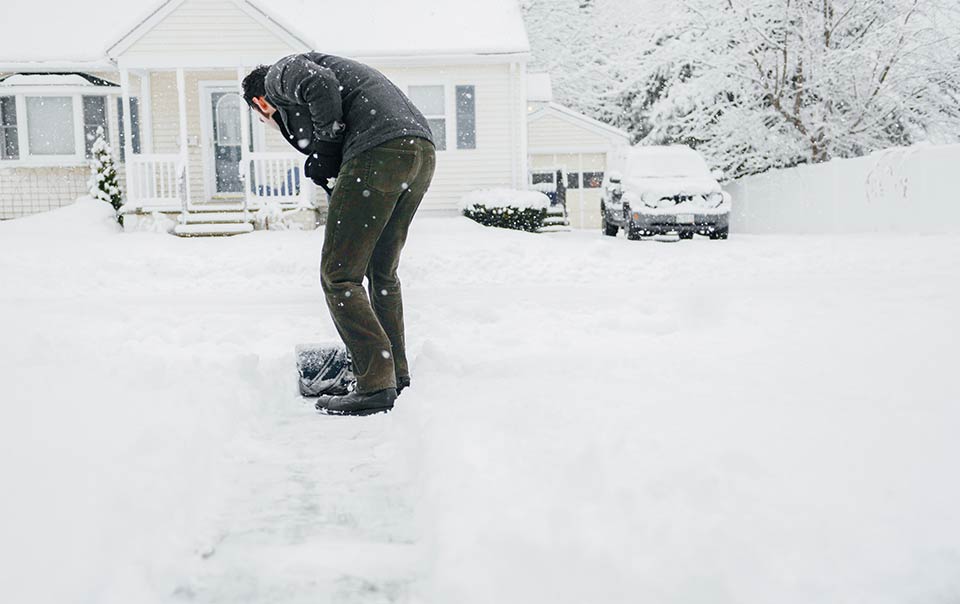
Person shoveling snow outside houseSnow shoveling can lead to a number of health risks for many people, from back injuries to heart attacks. The mix of cold temperatures and physical exertion increases the workload on the heart,¹ which may increase the risk of a heart attack for some. According to the American Heart Association, even walking through heavy, wet snow can place strain on your heart.
The following tips can help keep you safer when you set out to shovel:
  • Warm up. Warm your muscles before heading out to shovel by doing some light movements, such as bending side to side or walking in place.
  • Push rather than lift. Pushing the snow with the shovel instead of lifting can help reduce the strain on your body. When lifting snow, bend your knees and use your legs when possible.
  • Choose your shovel wisely. Ergonomically-designed shovels can help reduce the amount of bending you have to do.
  • Lighten your load. Consider using a lighter-weight plastic shovel instead of a metal one to help decrease the weight being lifted.
  • Hit the pause button. Pace yourself and be sure to take frequent breaks. Consider taking a break after 20 to 30 minutes of shoveling, especially when the snow is wet.
  • Consider multiple trips. Consider shoveling periodically throughout the storm to avoid having to move large amounts of snow at once.
  • Keep up with snowfall. Try to shovel snow shortly after it falls, when it is lighter and fluffier. The longer snow stays on the ground, the wetter it can become. Wet snow is heavier and harder to move.
  • Wear layers. Dress in layers and remove them as you get warm to help maintain a comfortable body temperature.
  • Stay hydrated. Drink plenty of water to stay hydrated while shoveling.
A national study² found that the most common shoveling-related injuries were to the lower back. Cardiac-related injuries account for only 7% of all injuries, but they were the most serious in nature. If you do not exercise on a regular basis, are middle-aged or older, or have any health conditions, such as heart disease or high blood pressure, you should check with your doctor before doing any strenuous shoveling. Consider using a snow blower or snow removal service as an alternative means of snow removal.

Snow and Ice Removal Requirements

Snow and ice not only pose a potential risk to you but also to others. As a property owner, you are responsible for making a reasonable effort to keep public walking areas around your property clear of snow and ice. Pre-treating your walkways and other paved surfaces with an anti-icing product can help make snow and ice removal easier.
Consider stocking up on ice melt in advance, as it sometimes sells out during long winters. You can store unused ice melt in an airtight container, out of reach from children and pets. Be aware that rock salt can damage brick, stone, asphalt and concrete walkways.
Be sure to check your local codes and ordinances regarding snow and ice removal requirements.


Sources:
¹ American Heart Association,
http://www.heart.org/HEARTORG/Affiliate/Shoveling-Snow-Health-Hazards_UCM_426562_Article.jsp
² Nationwide Children's,
http://www.nationwidechildrens.org/news-room-articles/new-national-study-finds-11500-emergency-department-visits-nearly-100-deaths-related-to-snow-shoveling-each-year?contentid=86424


I would like to acknowledge Travelers Canada for the publication of this article. This content was sourced on January 26, 2016.

Wednesday, October 8, 2014

Should you buy rental car insurance?


While economical, declining insurance coverage when renting a car may not always be the best choice.

Thinking of renting a car? Whether you settle on the compact or splurge for the SUV, you may have a more important decision to make before you get to the counter: whether to purchase rental car insurance.

It’s a difficult decision, given the fact that you may already be covered through your existing car insurance or your credit card. Rental car insurance, also known as optional vehicle protection or loss-damage waiver can cost as much as $22 per day and shifts liability for collision damage from the person renting the car back to the car rental company. It will generally kick in if the car is vandalized or stolen as well. The other “accept or decline” decision involves liability insurance, which usually provides protection for up to $1 million and costs about $10 a day over the rental charge. Most major credit card providers offer rental insurance to cardholders, but often they only make it available to higher-level members, so check with your credit card company first. Even then, credit cards usually cover damage to loss or the rented vehicle, not for other cars, persons, or property.

Generally your existing auto insurance will cover you when your rent a car, provided you are using it for recreation and not for business. In other words, running about town shouldn't be a problem, but renting a vehicle that helps you earn a living might be. The type of vehicle you rent will also affect your coverage. If you’re renting a cargo van to move someone back to school, for instance, or picking up supplies for the garden, it’s unlikely that your personal or credit card policy will cover you. If your existing car insurance policy includes collision and comprehensive coverage, then this should also cover the rental as well, but only within the limits of your current coverage. If you have dropped comprehensive or collision coverage from your insurance on your older car, you would be exposed if your rental car is stolen or damaged in an accident.

During an accident on a rental, there are a couple things to keep in mind:

·         Your insurance coverage deductible applies to the rental like if it was your own vehicle.  You are responsible for the deductible amount so consider is the “per day” cost of the rental coverage is going to amount more than your deductible.

·         You’re exposed if you are renting a vehicle while your insured vehicle is also on the road.

·         Keep in mind your own coverage limitations because they will transfer to the rental vehicle as well.
·         When driving across the border, as yourself if your coverage extends across with you.


By accepting the rental coverage at the counter, you avoid all of this. Your insurance company won’t generally be notified since it’s actually not involved in your accident on the rental.

The Increasing Risk of Water Damage

Water Damage is on the rise

Water Damage has now surpassed fire as the leading cause of personal property claims. It is estimated that, on average, the Canadian insurance industry pays about $1.7 billion per year in claims due to water damage, and here is why:

·         Changing weather, unpredictable weather patterns
·         Increased precipitation
·         Aging municipal structures (water and sewer pipelines)
·         Home improvement trends, i.e. basement family rooms
·         Increased use of hot tubs, dishwashers and other operating appliances

Home insurance was created when fire was the major cause of loss, and homes did not have finished basements with expensive furnishings as they often do today. There are possible ways to save on your home insurance’s water damage premium if applied correctly:

·         Keeping an unfinished basement can save on water damage or water escape premiums
·         A tank less water heater can impact savings
·         A hot water tank that is less than 6 years old can also save on your premium
·         Installing an automatic water shut-off valve and sensors

·         A professionally installed sump pump or backwater valve can save on water back-up or water escape premiums


Flood vs. Sewer Backup/Water Escape Backup Coverage: What you should know

A 2004 survey conducted for the Insurance Bureau of Canada found that nearly 61% of Canadians mistakenly believe that their home insurance provides coverage for overland flooding. The truth of the matter is that the home insurance currently offer to Canadians regardless of where they live does not cover storm surges and overland flooding.
Too much water in urban areas poses a different risk. Sewer back-up occurs when the city municipal drainage system overflows and sends water back through the pipes and into your home. This may happen for a variety of reasons, but the most common is a great deal of water from rainfall or snow melt overwhelming the system.
Sewer back-up/water escape coverage is available for purchase as an add-on to an existing home insurance policy. As with any optional coverage, it is subject to the underwriting guidelines set out by your insurer, so please contact us at Sturino & Associates Insurance Brokers Ltd to make sure you are protected.

A Few Tips on How to Prevent Water Damage

·         Backwater Valves should be installed by a professional plumber, and should allow acces for regular maintenance.
·         Disconnect all downspouts connected to the municipal sewer system.
·         Make sure downspouts extend at least 6 feet (where possible) from exterior walls and drain away from the house.
·         Replace aging fixtures, tubs and toilets.
·         Ensure the home is checked during absences, especially during the heating season.
·         Consider switching to a tank less water heater.

Many municipalities have programs in place to help deal with sewer bac-up/water escape issues. Please contact us or stop by for additional resources and information on how to prevent water damage.

7 Jopling Avenue South
Etobicoke, ON M9B 3P4
416-231-9980

Source: Insurance Bureau of Canada – Telling the Weather Story

Friday, September 26, 2014

Aviso importante!!
Programa de Medidores de Agua

El Ayuntamiento de Toronto está poniendo en marcha un programa obligatorio de medidores de agua en todo Toronto e instalará o mejorará los medidores de agua en su zona. Este programa asegurará la continua precisión de sus facturas del agua y mejorará las eficiencias de las lecturas de los medidores.
  • Este programa es obligatorio para todas las viviendas de Toronto, tal y como ha sido aprobado por el Ayuntamiento, de conformidad con el Código Municipal de la Ciudad de Toronto, Capítulo 851, Suministro de agua.
  • La instalación o el medidor de agua son gratis para los propietarios de las viviendas.
  • Los instaladores necesitarán tener acceso al interior de su vivienda.
  • Una persona de 18 años de edad o mayor debe estar presente durante la instalación.
  • La instalación durará 90 minutos para los clientes que no tienen actualmente un medidor de agua (clientes de tarifa fija) y 30 minutos para los clientes que ya tienen medidores de agua.

Pueden pedirse citas llamando al: 416-23-METER(416-236-3837) o en línea en
toronto.ca/watermeterprogram. Si es necesario, hay intérpretes disponibles durante el horario del centro de llamadas para asistirle, por favor pida un intérprete cuando hable con un(a) operador(a). Nuestro sitio Web también contiene información en este idioma.

Horario de la cita de instalacion - Lunes a Viernes:
  • Dia - de 8am a 12pm
  • Tarde - de 12pm a 4pm
  • Noche - de 4pm a 8pm

Horario de la cita de instalacion - Sabado y Domingo:
  • Tarde - de 12pm a 4pm
  • Noche - de 4pm a 8pm
Todos los propietarios de viviendas recibirán el mismo medidor de agua (del tamaño aproximado de un balón de fútbol), que tiene una unidad transmisora inalámbrica aparte (de aproximadamente 15 cm por 10 cm por 5 cm) montada cerca. Todos los datos enviados están protegidos y contienen sólo el número de serie del medidor de agua y los datos sobre consumo. No se transmite ninguna información identificable. El medidor de agua se colocará justo después de la llave de paso principal, o si usted ya tiene un medidor de agua, se instalará en el lugar donde se encuentra su antiguo medidor. Neptune Technology Group, bajo contrato con el Ayuntamiento, realizará todas las mejoras e instalaciones.
Por favor compruebe su llave de paso principal y asegúrese de que esté funcionando correctamente antes de pedir una cita. Si no sabe cómo hacerlo, o si la llave está defectuosa, informe al operador cuando concierte su cita. 
Los instaladores deben poder tener acceso a su llave de paso principal (y al medidor de agua
existente, si tiene uno). Si alguno de ellos está obstruido por una pared, su instalador, tras consultar con usted, puede cortar una abertura para tener acceso. Los propietarios de viviendas pueden elegir crear su propio acceso cortando ellos mismos una abertura de 48 cm por 38 cm. Puede solicitarse una tapa o panel de acceso para ocultar el agujero después de la instalación. No se cobra por el trabajo realizado durante la instalación o por la tapa o panel de acceso.

Water Meter Program

We are proud to advise you as part of our ongoing insurance information program, specifically surrounding the subject of water, the following public service announcement for the city of Toronto.
The following piece of information highlights steps and procedures that must be followed in order to adapt to the new water reading system. This is also an ideal time to check the water shut off valve in your home or office to insure that it is fully operational.
This service is provided at no cost, and to the best of our understanding, its mandatory. You can direct your calls and inquiries to the numbers outlined on the following piece of information provided by the city of Toronto.

The Program

The City of Toronto is implementing a mandatory water meter program that will replace or install new automated meters in every home and business in the city, to provide an equitable system for all Toronto Water customers.
 The new system will help to keep better track of water consumption across the city, detect water loss more quickly and eliminate the need for City staff to go to homes to obtain water meter readings. It will also provide environmental benefits.
The program will be rolling out on a ward-by-ward basis. Residents will be notified by mail when installations begin in their wards.

A New Water Reading System

Your water meter will be part of the City's new automated reading system. This new technology will integrate all water meter reading, data storage and billing across the City of Toronto into one seamless system. Once installed, each water meter across the city will send data, several times a day, to a series of collection units. The data is then sent to a central server, which allows for fast, secure access and storage of all information.

All data contains only the water meter serial number and consumption data. No identifiable homeowner information is transmitted. The radio frequency used by the transmitter is a licensed frequency on which only water meters can operate.

Under the new system, all customers will pay for the water they actually use. The City will provide meters to those who were previously on a flat rate system and replace old existing meters with more efficient and up-to-date technology. Being aware of water use - and therefore being able to use water more efficiently - leads to benefits for all Torontonians.

About your free installation appointment

Appointments can be made by calling 416-23-METER (416-236-3837) or online at: Toronto.ca/watermeterprogram. Installations will take from 30 to 90 minutes and someone 18 years or older must be present. There are three different time blocks for appointments Monday to Friday as followed:
  • Morning block 8am to 12pm
  • Afternoon block 12pm to 4pm
  • Evening block 4pm to 8pm

Two additional weekend appointment blocks are also available as followed:
  • Morning block 9am to 1pm
  • Afternoon 1pm to 6pm
Prior to the installation please verify that your water main shut-off is working properly. If you are unsure how to do this, or the valve is faulty, please inform our operators when scheduling your appointment.
  • Only a Neptune installer can upgrade your water meter, and they will arrive at your home with photo ID and in uniform.
  • No installer will ask for any money at the door.
  • All installations will be done without charge to homeowners.
  • All installers are certified and trained to install water meters as per Ontario standards WMI-08.
  • The installation will take approximately 90 minutes for new meter installations and 30 minutes for homeowners with existing meters.
  • Homeowners can call 416-23-METER (416-236-3837) to verify the identity of an installer. Operators will have access to all installer information, including a photo.

Monday, September 22, 2014

Stringent mandate on Ship Owner’s Liability rules for pollution insurance as voted by House of Commons.


A billed passed on September 18th of 2014 that could mandate strict rulings on liability and compulsory insurance on ship owners, as well as indemnification of airlines and aviation firms in case of losses incurred from acts of war and terrorism.

If accepted by Senate, bill C-3 would become a new called the ‘Aviation Industry Indemnity Act’, and it would have an impact on laws like the ‘Marine Liability Act’, the ‘Canada Shipping Act’, the ‘Marine Liability Act’, and other acts where hazard components and pollution might be a factor.

Paraphrasing Transport Minister Lisa Raitt on the May 8th reading of the bill, as of today ship owners are not held to strict liability measures; it is up to the victims to prove fault of negligence on part of the owner of the vessel. These amendments would alleviate the burden carried by victims and make the compensation available guaranteed.

The federal government is proposing to implement within the bill certain provisions from the HNS convention, where it stipulates that the owner of the vessel at the time of the incident “shall be liable for damage caused by any hazardous and noxious substances in connection with their carriage by sea on board the ship” under certain conditions.

Another provision of Bill C-3 would let the federal transport minister “Undertake to indemnify one or more aviation industry participants – or one or more classes of aviation industry participant – against their loss of damage, or liability for loss or damage, that is caused by an event”

The act defines “event” as either “an act of unlawful interference with an aircraft, airport or air navigation facility, including an act of terrorism” or “an act or omission in the course of armed conflict, war, invasion, hostilities, civil war, revolution, rebellion, insurrection, an application of martial law, a usurpation or attempted usurpation of power, a civil commotion or a riot.”

In its definition of “aviation industry participants,” Bill C-3 includes: air carriers; NAV Canada; contractors providing air navigation products and services; airport owners and operators. It also applies to suppliers who “directly support the operation of aircraft from an airport,” such as: freight forwarders; airport security organizations; contractors who maintain and clean aircraft; and contractors who load and unload passengers, baggage and cargo.

Members of the opposition New Democratic Party (NDP) expressed several misgivings about C-3 but indicated they would support it because it’s an improvement over the status quo.

"In a conflict situation, if airlines stop flying to certain regions for insurance purposes, humanitarian aid might be compromised, as it may no longer be able to get there," said Christine Moore, NDP MP for Abitibi-Témiscamingue, Quebec, on Sept. 18. "It might take considerably longer for aid to get there when humanitarian workers have to land in countries that are much further away and travel the rest of the route by land. Providing compensation to the airlines might help keep certain flights to risk areas so that the people can continue to benefit from the humanitarian help they need."


Some opposition MPs criticized the bill on the grounds that it does not impose on ship owners a higher amount of strict liability and for not amending the bill to prevent Canadian taxpayers from being on the hook for damages, from spills at sea, of greater than $500 million. The bill underwent hearings last March by the Standing Committee on Transport, Infrastructure and Communities, but was returned to the Commons with no amendments from the original version tabled in October, 2013.


"The liability scheme that was created for this talked about ship owners’ liability limited to $230 million," said Glenn Thibeault, NDP MP for Sudbury, Ont. on Sept. 18. "Damages in excess of ship owners’ liability were to be paid by an international fund, which is that HNS fund, up to a maximum of $500 million."


The content was sourced on Sept 19, 2014 by Canadian Underwriter.ca


Newfoundland judge dismisses moose vehicle collision class action lawsuit


ST. JOHN'S, N.L. – A judge in Newfoundland and Labrador has dismissed a class-action lawsuit that claimed the provincial government was negligent by failing to do enough to protect drivers from moose-vehicle collisions.

Provincial Supreme Court Judge Robert Stack delivered his decision Friday, saying the provincial government was not liable for the collisions and implemented an appropriate accident-prevention policy.

Stack's ruling also says that one of the plaintiffs' key witnesses, wildlife expert Dr. Tony Clevenger, was biased, unreliable and provided misleading information.

The class-action lawsuit included people who were seriously injured since 2001 and several estates of those who have been killed.

Ches Crosbie, the lawyer representing the plaintiffs, had argued the province knew for at least 10 years that moose pose a hazard on the highways but did not decide on a specific policy to reduce that risk.

Crosbie issued a statement Friday saying the decision was a ''moral victory'' for the plaintiffs because the government has responded to the lawsuit by taking action to reduce moose-vehicle collisions.


This content was sourced on Sept 19, 2014 by Canadian Underwriter.ca


Monday, July 7, 2014

A well developed Fire Escape Plan could save your family


If a fire occurred in your home today, would your family get out safely?

Everyone must know what to do and where to go when the smoke alarm sounds. Take a few minutes with everyone in your household to make a home fire escape plan, following these steps:


Draw a floor plan of your home

Use a grid notebook to draw a plan for each level of your home and include all possible emergency exits. Draw in all the doors, windows, and stairways. this will show you and your family all possible escape routes at a glance. Include any features such as the roof of a garage or porch, that would help in escape.

Show two ways out of every room, if possible

The door will be the main exit from each room. However, if the door is blocked by smoke or fire, identify an alternate escape route, which could be a window. Make sure that all windows can open easily and that everyone knows how to escape through them safely. if windows have security bars, equip them with quick releasing devices.

Does anyone need help to escape?

Decide in advance who will assist the very young, older adults, or people with disabilities in your household. A few minutes of planning will save valuable seconds in a real emergency.

Choose a meeting place outside

Choose a meeting place a safe distance from your home that everyone will remember. A tree, street light, or a neighbor's home are all good choices. In case of a fire, everyone should head to this meeting place so you and your family is all accounted for.

Call the fire department outside your home

Don't waste valuable seconds calling the fire department from inside your home. Once you have safely escaped, call the fire department from a cell phone or a neighbor's home.

Practice your escape

Review the plan with everyone in your household and walk through all the escape routes. Make sure all the exits are practical and easy to use and practice so you wont hesitate as your escape routes may be quickly blocked by smoke or flames.

REMEMBER


  • Plan two ways out of every room if possible
  • Once out always stay out - never re-enter a burning building
  • Hold a fire drill twice a year

If you live in a high-rise apartment building, contact the property manager or superintendent for information on your building's fire safety plan. 

At Sturino & Associates we want you to get the most up to date information and cater to all of your insurance needs. for more information call us at 416-233-8252 or drop by locally at 7 Jopling Avenue S. Etobicoke, ON.


H.F.S.T. (Home Fire Safety Tips)


Weather you are a brand new home owner or have owned your home for a few years now, it is always important to set down some prevention initiatives for your home. These initiatives can make a difference when disaster strikes.

At Sturino & Associates, we want to make sure that you and your family are aware of the best practices to protect your investment, the following are some tips to prevent, detect, and escape in case of a fire at your home.

Prevention

  • Ensure that all matches and lighters are out of the sight and reach of children
  • Teach young children not to touch matches or lighters
  • Always stay in the kitchen when you are cooking
  • keep children at least one meter from the stove
  • If you are sleepy or have consumed alcohol, don't use the stove
  • Always blow out candles before leaving a room
  • If anyone is the home smokes, smoke outside
  • Ensure that you have no overloaded electrical outlets or circuits
  • Extension cords must be used only as a temporary connection
  • Ensure that items that can burn easily are at least one meter away from space heaters or any ignition source

Detection

  • Ensure working smoke alarms are installed on every story of your home and outside all sleeping areas - It's the law and the responsibility of every homeowner and every landlord!
  • For extra protection, install a smoke alarm in every bedroom
  • Install smoke alarms with a "hush" feature to silence nuisance alarms - never remove batteries of disconnect smoke alarms
  • Use of Photoelectric smoke alarms may reduce the frequency of nuisance alarms outside the kitchen and bathroom
  • Ensure a carbon monoxide alarm is installed outside of sleeping areas in homes with a fuel burning appliance or attached garage - It's the law and the responsibility of every homeowner and every landlord!
  • Test your smoke and carbon monoxide alarms at least once a month
  • change smoke and carbon monoxide alarm batteries annually and whenever the lo-battery warning sounds 
  • Smoke and carbon monoxide alarms have a limited lifespan. In general, replace smoke alarms that are more than 10 years old and carbon monoxide alarms that are more than 7 years old. Check with the alarm manufacturer or the manufacturer's instructions for complete details
  • Always follow the manufacturer's instructions for installing, testing, maintaining and replacing smoke and carbon monoxide alarms

Escape

  • Develop a home and fire escape plan and practice with the entire family - You may have less than one minute to escape a fire emergency
  • Keep all exits at home clear and easy to use